Company Overview
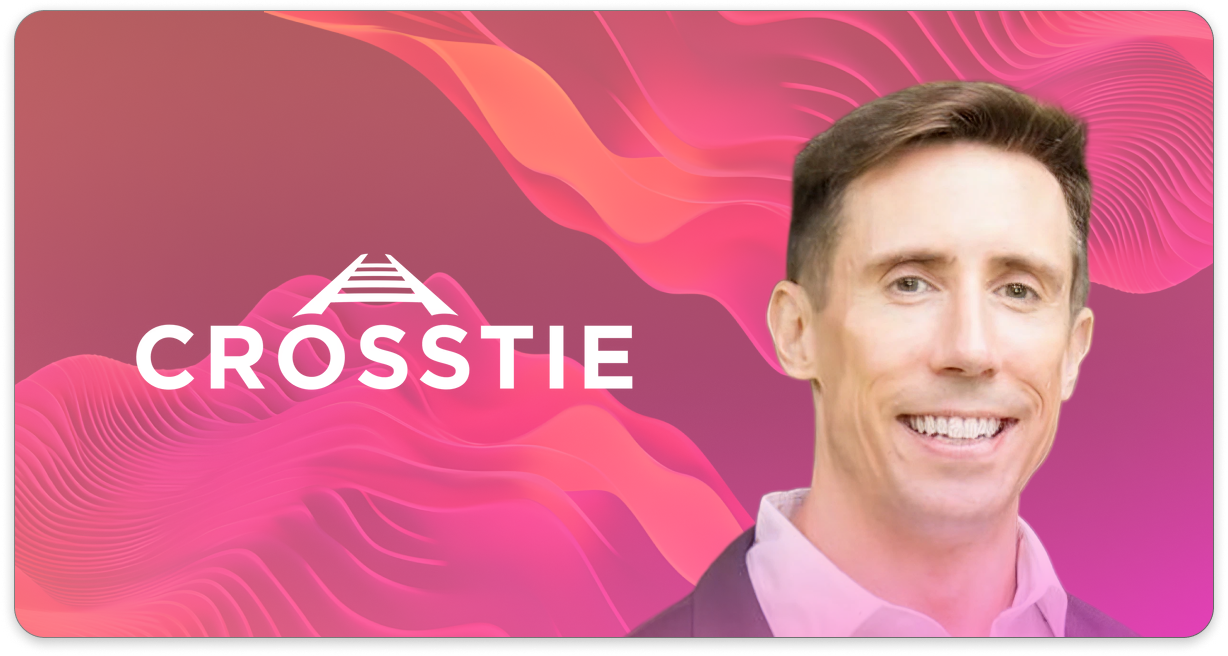
Sean Eldridge is Co-Founder & CEO of Crosstie an AI-powered workflow automation platform for property and casualty (P&C) insurance operations. Learn more at https://crosstietech.com.
Can you tell us a little about your background before starting at your company?
Before Crosstie, my career had two main chapters. The first was building and launching new ventures inside large public companies, including Johnson & Johnson, Procter & Gamble, and WeightWatchers. The second was working in more entrepreneurial environments, including co-founding a digital health startup and leading a private equity-backed rollup in the property damage restoration industry.
The unifying thread across these experiences has been a desire to help people navigate difficult moments, whether through behavioral science and technology, or simply by showing up when disaster strikes. I’m thankful for each of these experiences and for the talented individuals I had the opportunity to work alongside, all of which helped prepare me to lead our team’s current venture, Crosstie.
How did you start at your company? What were the first steps you took to get it off the ground and how did you identify the need for your product/service in the market?
My co-founder, John, and I were building a digital health company when we came across the Workers’ Compensation Benchmarking Study. What we read stopped us in our tracks. It described a problem that was both deeply human and operationally solvable, and we couldn’t let it go.
The claims process affects people at vulnerable moments. For someone navigating a claim after an accident or workplace injury, the experience can be confusing, stressful, and opaque. For the professionals handling those claims, it can mean enormous administrative burden, fragmented systems, and too little time to focus on the work that actually moves a claim forward. We made the decision to sunset our digital health business and go all-in on what would become Crosstie, which we built out of Harvard’s Innovation Lab.
Our initial idea was to create a TurboTax-like experience for claims, something that could guide people through the process, improve communication, reduce administrative work, and help claims resolve more efficiently. Before writing a line of code, we spent roughly 5,000 hours speaking with claimants, adjusters, claims leaders, and other stakeholders across the industry. That research shaped our earliest product and gave us the conviction that the opportunity was much bigger than a single claimant-facing experience. We went live with our first customer in early 2020, and since then, our roadmap has continued to be shaped by the real-world friction points our customers ask us to solve.
What innovations or unique features set your company apart from others in the industry?
Three things set Crosstie apart.
First, we jumped into insurance because a specific problem pulled at our heartstrings, not because we read a market analysis saying the P&C market was massive or that large parts of it still run on legacy technology. The stories we heard from claimants and claims professionals during our research deepened that conviction, and it shapes everything about how we build.
Second, we let customers drive our roadmap, and we still do. We didn’t enter the P&C space as claims experts, so we listened from day one. Every major capability we’ve built has come from seeing a specific problem inside a customer’s operation and deciding to solve it.
Third, we’ve built Crosstie as a configurable workflow orchestration layer for P&C insurance, not as another disconnected point solution. Claims organizations already have core systems, document management systems, and communication tools. Crosstie sits on top of those systems and helps orchestrate workflows across FNOL, document processing, voice, messaging, claimant and customer self-service portals, claim intelligence, and even loss control. Customers can start with the problem that matters most and expand over time, rather than stitching together a growing list of vendors and integrations.
What has been the most effective strategy for scaling your business?
The most effective strategy has been delivering for customers. Insurance is a relationship business, and trust compounds over time. When customers see that our team actively listens, understands their workflows, follows through on implementation, and continues improving after launch, they become evangelists.
That has been the biggest driver of our growth. We’ve also been intentional about earning the right to expand. Many customers start with one specific workflow or pain point, and as they see results, they look for additional ways to use our platform across their operations. That only works if the initial deployment creates real value.
Looking ahead, what are your goals for the future of your company?
We believe the future of claims will be both human and agentic.
AI agents will handle more of the routine work that slows claims down today: coordination, documentation, follow-up, status updates, and information gathering. That’s not a small thing. It is a meaningful share of what consumes an adjuster’s day. Freeing adjusters from that work means they can spend more time on the parts of claims that actually require a person: the judgment calls, the difficult conversations, and the moments where empathy matters.
Our goal is to make Crosstie the orchestration layer that helps insurance organizations get there. We want to help carriers, TPAs, self-insureds, MGAs, and service providers resolve claims faster, reduce unnecessary costs, and create a clearer experience for everyone involved. We’re trying to make insurance work better for both sides of the claim: the professionals who are often buried in administrative complexity, and the people relying on insurance during some of the most stressful moments of their lives. That’s a future worth building toward.